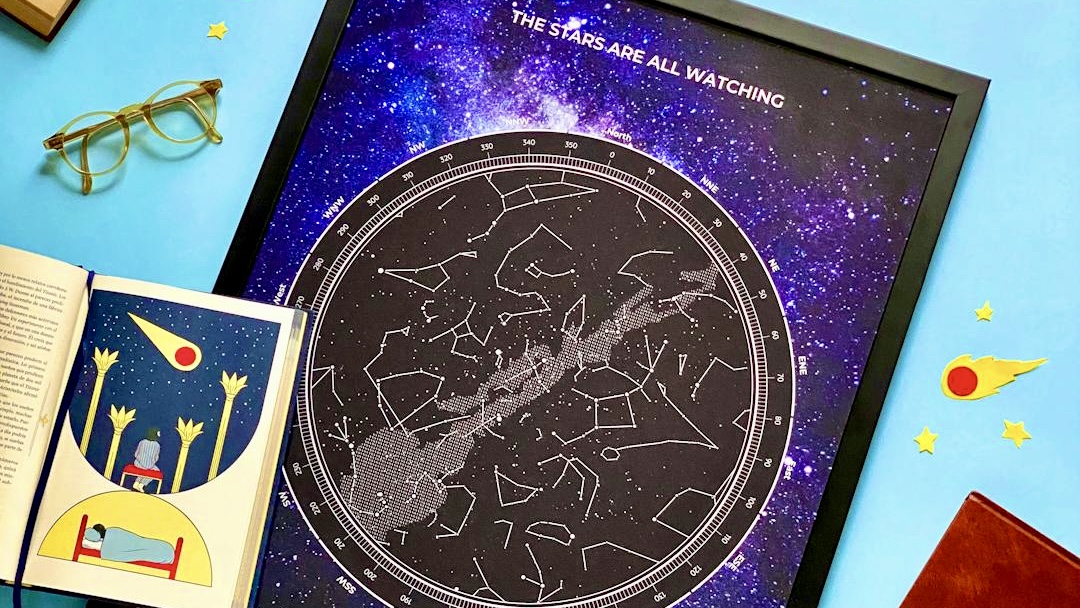
Our home galaxy, is the Milky Way. It is the featured on all of our Star Maps, with its position determined by the unique time, place, and date you choose for us to plot. If you are lucky enough to be somewhere with very little light pollution then you will be able to see it when you look up at the night sky.
Whilst it’s easy to think of the Milky Way as simply a collection of stars scattered across the darkness, it’s actually something far more spectacular?
The Milky Way is a spiral galaxy, made up of enormous sweeping arms that stretch outward and rotate around a bright central core. If we could somehow travel far beyond our galaxy and look back at it from above, it would resemble a gigantic cosmic pinwheel spinning through space.
Our own Solar System sits about halfway between the galaxy's centre and its outer edge, tucked away in a smaller spiral arm called the Orion Arm. This means we're not in the bustling heart of the Milky Way, but rather in a relatively quiet corner of our galactic neighbourhood.
At the very heart of our galaxy lies something truly extraordinary: a supermassive black hole. Known as Sagittarius A* (yes, that's really its name, complete with the little star symbol!), this cosmic giant has a mass approximately 4 million times greater than our Sun. Its immense gravitational pull influences everything around it, making it one of the most fascinating objects in our galaxy.
But perhaps the most mind-blowing fact of all is the sheer scale of the Milky Way. Our galaxy stretches an astonishing 100,000 light-years across. To put that into perspective, light — the fastest thing in the universe — would take 100,000 years to travel from one side to the other!
Despite its enormous size, the Milky Way is just one galaxy among billions of galaxies scattered throughout the universe. Our cosmic home, vast as it seems, is just a tiny part of an unimaginably large neighbourhood filled with stars, planets and mysteries waiting to be discovered.
The next time you look up at the night sky, remember: you're not just looking at random stars. You're gazing out from a remarkable spiral galaxy that has been spinning through space for billions of years — and it's the place we call home. ✨
But not all galaxies are created equal! Astronomers generally group galaxies into four main types:
- Spiral galaxies like the Milky Way, with beautiful winding arms filled with stars, gas and dust.
- Elliptical galaxies, which are more rounded or oval-shaped and tend to contain older stars.
- Lenticular galaxies are a cross between spirals and ellipticals. They have a central bulge like spiral galaxies, but their arms are much less distinct. But like elliptical galaxies they are generally older stars.
- Irregular galaxies, which have no clear shape at all and often look chaotic due to past collisions or gravitational interactions with other galaxies.
Some galaxies are relatively small, containing just a few million stars, while others are true giants with trillions of stars. The largest known galaxies dwarf our own Milky Way, reminding us just how diverse and extraordinary the universe really is.
Quiz Time! 🌟
Q. Do you have any idea how many stars are hanging out with us in the Milky Way?
Approximately :-
A. 100 thousand
B. 100 million
C. 100 billion
D. 1 trillion
**Take your best guess, and let us know what you think!
Email us support@underluckystars.com 1st 10 correct answers received before July 2, 2026, will win.**
Want more space trivia? Check out our blog https://www.underluckystars.com/blog